Staff review
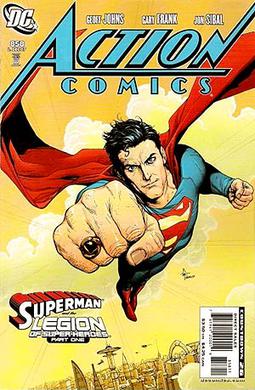
Superman and the Legion of Super-Heroes
Hate had no place in his world
8.5
Staff write-up
The Rev
One of the absolute greatest Superman runs of all time sits squarely in Geoff Johns' run from the mid 2000s. Johns managed to perfectly channel the old-school, optimistic charm of the Christopher Reeve era while dragging its underlying themes kicking and screaming into the modern day.
Usually, I am skeptical of future or multiverse storylines. They tend to strip the autonomy away from our heroes, leaving everything up to pre-ordained fate. If the future is already written, why should we care about the stakes of the present? So, when I initially cracked open Superman and the Legion of Super-Heroes, I went in with a bit of a wet blanket mentality. Fortunately, because Johns was at the helm, I kept an open mind and the narrative delivered something profoundly deeper than a standard time-travel gimmick.
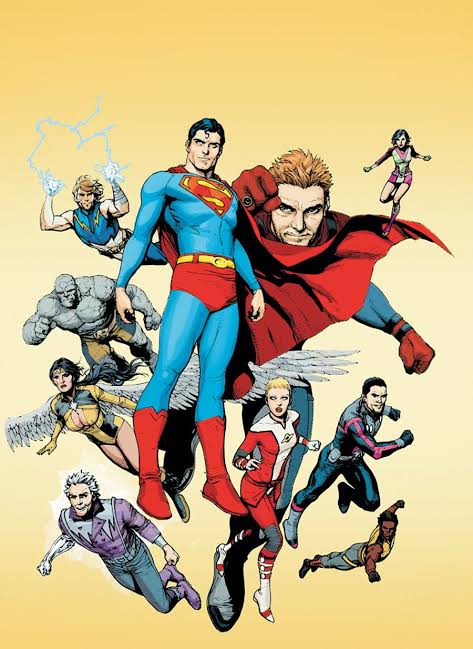
First, Gary Frank’s artwork work is absolutely top-notch. It feels genuinely iconic and serves as the perfect modern continuation of the Christopher Reeve aesthetic.
The premise of this arc is heavy, it's eerie how accurately it parallels modern political brainwashing, xenophobia, and the weaponization of misinformation nearly two decades before the current political climate took hold.
In the 31st century, a xenophobic, human-supremacist ideology has completely overtaken Earth. Aliens are actively blamed for all of society's problems. Worse yet, history has been entirely reinterpreted and rewritten: the regime claims that Superman was not a Kryptonian at all, but rather a human who vehemently hated aliens. The iconic "S" shield has been twisted from a beacon of hope into a symbol of hate and intolerance.
Naturally, Clark cannot let that stand. But his powers are completely muted because the current regime has manipulated Earth's sun to burn red. He is essentially just a normal, vulnerable man stranded in a messed up, Nazi-like world.
This regime is spearheaded by Kirt Niedrigh, aka Earth-Man. He is essentially a Homelander-esque psychopath who spews false narratives to maintain control. But underneath the propaganda, Earth-Man is just a deeply damaged, insecure child. His entire worldview is rooted in a toxic need for validation after he was rejected by the original Legion of Super-Heroes. Instead of looking inward and trying to better himself, Earth-Man took the easiest route possible, fear-mongering and xenophobia. It is a brilliant deconstruction of how petty grievances can mutate into fascism.
So, what is a Superman to do when he is only a "man"? The idea of fighting ingrained prejudice and institutional propaganda seems completely impossible, but Clark believes the regime is just a house of cards waiting to be toppled by the truth. He refuses to back down. He organizes a band of resistance fighters, infiltrating a brutal gulag-style prison to recruit allies and save fellow superheroes from eternal imprisonment. They forge a united coalition against the regime while Clark investigates the source of the red sun.
The plot kicks into high gear when they discover the missing Legionnaire, Sun Boy, is being imprisoned and drained to manipulate the sun's natural radiation. Once they extract him, the sun begins to heal. This leads to a massive, knockdown, drag-out brawl where Earth-Man reveals he can co-opt nearby superpowers (a perfect physical manifestation of how he co-opts historical narratives) but as the yellow sun returns, so does Clark's strength.
With a true beacon of hope to rally behind, Superman and his coalition defeat Earth-Man, expose his fragile lies, and shatter the blanket of misinformation suffocating society.
The moral of the story is perfectly executed. Superman is not defined by his physical strength. He is the sum of his resilience, his fortitude, and his honesty. In other words, Superman’s humanity is what actually wins the day. He proves that the citizens of the 31st century were not inherently evil, they were just naive, manipulated, and heavily gaslit.
Truth eventually prevails over tyranny, and a broken world can heal once the poison of misinformation is extracted. This arc is an amazing read that feels much less like a standard comic book and much more like a sobering history lesson and a stark warning for the present.
Same vibe
Related Revs
-1.jpeg)
.jpeg)
.jpeg)
.jpeg)
.jpeg)
.jpeg)
Same desk