Staff review
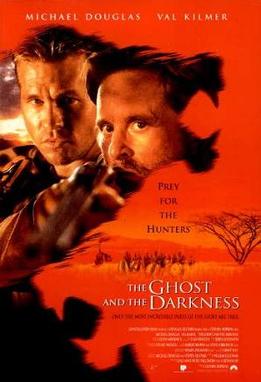
The Ghost and the Darkness
The devil has come to Tsavo
8.5
One Sec.
Loading Details...
Staff write-up
The Rev
I am going to tell you exactly why The Ghost and the Darkness is a movie on par with cinematic greats like Jaws. The story of two man-eating lions wreaking havoc on a railway build site in Africa is a horrifying masterclass in tension, character development, and survival horror. The biggest knock against it is Stephen Hopkins and his highly uneven direction. He relies on some truly corny framing and effects shots, including terrible CGI, choices like the cheesy mirror reveal of both beasts, slow mo, and bizarre fade-outs scattered throughout the runtime. But everything else here is so top shelf that I find it insane this movie is not held in higher regard.
The narrative perfectly balances all the classic thematic elements. You get man versus man, man versus nature, man versus machine, and man versus faith. Val Kilmer does his best as Patterson, but he is by far the weakest link in the cast. Everyone else elevates the material, especially John Kani as Samuel and Michael Douglas as Remington. Tom Wilkinson plays Beaumont like an old-school pro wrestling villain. He is not one of these nuanced, modern antagonists. He is just delightfully cruel and highly effective.
The film delivers some of the best jump scares in the genre, utilizing timing, volume, and mounting tension to provide genuine terror rather than cheap thrills. The first attack is brutal, heavily aided by Dr. Hawthorne's grim description of the horrific aftermath. It is a remarkably soft R rating, but it never feels sanitized. The daylight attack is particularly haunting. I love the way Kilmer coldly assesses the scene, respecting the raw power at play while everyone else around him is visibly terrified. Furthermore, let us appreciate the real animal actors here, who are much more reputable and terrifying than the chaotic mess we saw in the movie Roar.
The character dynamics are brilliant. The great white hero arrives to save the day, but the lions are too clever, meaning the great white hunter needs a second great white hunter to save him, who is ultimately also outsmarted by these beats. Patterson's book smarts inevitably lose to Remington's gritty street smarts. Douglas is the perfect kind of grimy and crazy-eyed for this role. We see their philosophical differences perfectly when Paterson trades rifles with the doctor making a massive rookie mistake. When Remington scolds him, Patterson's body language says he should have known better. The fact that the two sides can work together so cohesively is an interesting pairing we do not see enough of.
Samuel also provides perfect exposition throughout the film. It is succinct, strictly in character, and sets up everything we need to know about the camp's fears without talking down to the audience. The world building within the camp is fantastic. The gathering after the first attack is extremely realistic. You see a messy, human response where some workers freeze in fear, some want to go on the offensive, and others just want to flee entirely. Fortifying the perimeter becomes a bonding experience through mental and physical labor. The campfire conversation about faith directly mirrors the famous Indianapolis speech Quint gives in Jaws. It serves as the turning point of the movie. Everything is about to hit the fan, so the script gives the characters one last night of reflection, laughs, and bonding.
The beautiful African landscapes are underutilized, I wish more of Pattereon's childlike wonder about the world around him was visualized. The score makes up for it though. The soundtrack is stirring, mixing precise orchestral movements with African chants and loud brass. When Remington leads the first hunt, the music is monumental.
Patterson's idea to tap the lions gets torn apart by Beaumont. What exactly is wrong with Patterson's plan for the trap door containment unit? Beaumont lays into him over it, but I never understood why the plan was inherently bad. Also, why would they put a baboon out under the platform as bait if they know lions hate baboons? You want to attract a man-eater, not keep it away. Perhaps the logic is that the lions hate baboons so much they feel compelled to eat them out of pure spite, but it feels like a weird tactical choice. There's a few logic gaps like these but they don't detract from the story.
The Stan Winston animatronics finally get their chance to shine toward the end with some fantastic close-ups. There is also a nightmare sequence involving Patterson's wife that is utterly terrifying. It messed me up as a kid.
Then we get to Remington's shocking death. As a kid, I did not understand it at all. He had plot armor, he was a massive star, he had the most experience, and he was the camp's last hope. Yet he dies, abruptly. We do not even get an on-screen death, which feels like a sleep in the face. It had to be a pay issue or a scheduling conflict with Douglas.
The climax on the bridge is definitely the cheesiest part of the film, but it is saved by the brutal struggle in the tree. The lion looks incredibly intimidating, and the sound design works overtime in the last fifteen minutes with phenomenal effects and scoring. Val Kilmer also cements himself as perhaps the worst kisser in Hollywood during his reunion scene with his wife.
Flaws and all, I absolutely love this movie. I have not seen the actual taxidermy lions at the Field Museum since I was a kid, but after revisiting this film, it is definitely time to head back.
Side notes: According to the firld museum, these lions did such a number in the human population because of teeth problems. Their root-tip abscess caused them to prefer allow moving and softer prey. They also had no manes, which the movie ignored (and rightfully so, these movie monsters look so fierce with their blood soaked mane) and the movie added Remington, who was a fictionalize character. Paterson supposedly took care of both lions after the number climbed into the mid 30s.
Same vibe
Related Revs
-1.jpeg)
.jpeg)
Same desk
-1.jpeg)