Staff review
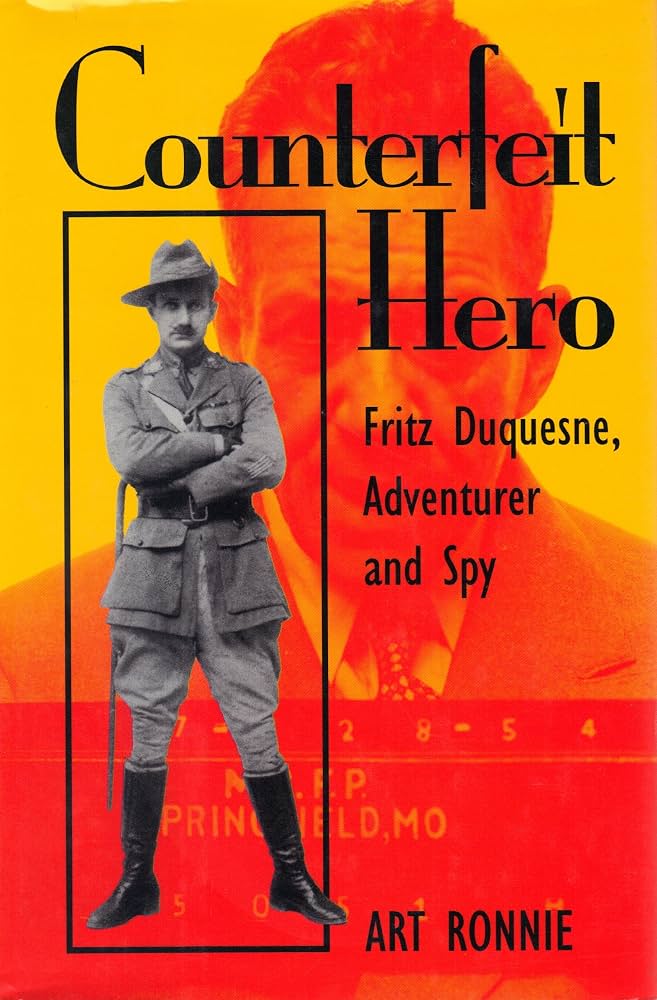
Fritz Duquesne: Counterfeit Hero
A life like no other

7.5
Staff write-up
The Rev
I first stumbled across the name Fritz Duquesne while reading about the bizarre, real world historical attempt to introduce hippos into the American meat supply. The man's story seemed absolutely wild. At one point considered the most wanted man in America, Duquesne lived a life that sounds significantly more like a pulp comic book villain than a grounded historical figure. He was a soldier of fortune, a Boer prisoner of war, a serial prison escapee, a pimp, an explorer, an environmentalist, a presidential adviser, a fraud, a spy, a saboteur, a murderer, and a certified lunatic.
The inherent problem with documenting Duquesne is pinning down exactly what is historical fact and what is embellished fiction. With only a handful of reliable written accounts mixed heavily with his own braggadocious tall tales, the actual truth likely lies somewhere in the murky middle. By his golden years, Duquesne himself could not even discern reality from his own compounding lies.
He possessed a pathological hatred for the British. As a young man, rather than avoid his British peers, he mastered their sports just so he could take vindictive jubilation in beating them at their own games. He even married a British woman. When questioned how someone who hated England so deeply could marry the enemy, he crassly rationalized that he was ravaging the British empire through her. Historical records indicate he actually just loved her, but his ego refused to let down the militant facade.
His life reads like a series of disjointed, chaotic cinematic set pieces. His first prison escape attempt ended poorly after he killed a guard and was caught waiting for an opening, landing him in solitary confinement awaiting execution. He eventually found employment as a pimp, jumped ship to avoid authorities, charmed a Vanderbilt with his tall tales to get a job as a deckhand, and then lived the life of a bindle carrying hobo in America. Or maybe none of that hobo stuff happened, because his naturalization paperwork tells a much more boring story. You truly never know with Fritz.
Chapter eight covers what is easily the most infamous portion of his life, which is the hippo farming scheme. Playing the role of political grand vizier, he pitched a plan to the Roosevelt administration to bring hippos to the American southeast to curb invasive foliage and provide a new meat source. It remains entirely unclear if he actually believed the ecological science or simply saw an opportunity for a massive, prolonged payday.
Later, after getting caught attempting to blow up merchant ships, he faked his own death to avoid treason charges. He then allegedly took a job to assassinate English military leader Lord Kitchener. When Kitchener's ship sank, Duquesne miraculously claimed to have escaped the icy doom that claimed everyone else on board.
Eventually, his past caught up to him. To avoid extradition, he faked insanity, faked medical ailments, and abused legal loopholes just long enough to orchestrate yet another escape. Leading up to World War II, he lent his espionage expertise to the fascist movement, running the infamous Duquesne Spy Ring for the Nazis in America. He claimed he was not antisemitic and was only helping Germany to hurt Britain, but his Jewish mistress clearly did not buy it and spent years feeding his secrets directly to the FBI. The federal agents tracking him noted a psychological tell. If he was not the absolute center of attention, Duquesne would aggressively steer the conversation toward niche topics where his audience was too ignorant to interject.
Duquesne lived a highly complicated, bloated, and aggressively undocumented life. Because of that, the book inevitably gets dry and bogged down at times. It is exhaustive in its coverage, but when a biographer is forced to juggle objective truth with a century of blatant lies and unverified first hand accounts, it becomes nearly impossible to tell a succinct, propulsive narrative. Things become significantly less interesting once Duquesne and his thirty plus associates are finally apprehended. From there on out, his life is entirely unremarkable. All the grandiosity was extinguished when he quietly passed away in a prison hospital bed. Doctors remained unsure if he was faking his final physical ailments and psychosis to the very end. But considering how Fritz Duquesne lived every single day of his life, maintaining the con even in death feels like the only fitting conclusion.
Same vibe
Related Revs
-1.jpeg)
.jpeg)
Same desk
-1.jpeg)