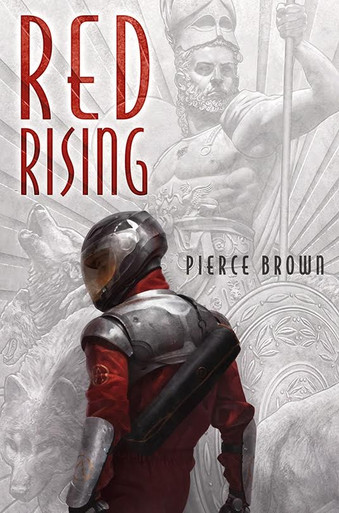
Staff review
Pierce Brown: Red Rising

7
Staff write-up
The Rev
The novel opens with a haunting revelation. The gravity on Mars requires you to snap your own family members' necks during hangings. Otherwise, they will slowly suffocate. It is an act of mercy, at least that's what you're told to think. That ominous setup never fully realizes its potential, unfortunately, in this uneven but enticing first chapter of the Red Rising saga.
Spoilers Below: We start by meeting Darrow. He is a Red working the mines of Mars. It is a hard and painful life built on a promise. The Reds believe they are laying the groundwork for future generations to someday colonize the surface. There's just one problem. They are being lied to. As the Reds toil away underground, the other classes live pampered lives on a fully terraformed surface. The Reds are given a manufactured pride that they do not even realize is being forced upon them.
Darrow's wife, Eo, ends up being executed quickly. In a highly preventable manner. She acts more like a MacGuffin to progress his journey rather than a fully fleshed-out character. Luckily, Darrow's memories throughout the book give us a deeper connection to her. We feel his loving remembrance before he is recruited by a rebel group called the Sons of Ares. They require him to infiltrate the upper-class "Institute." This is a brutal training ground to find those worthy of leading. Darrow's mission is to bring the elites down from the inside. What follows is a satisfying mashup of Lord of the Flies, The Hunger Games, and The Running Man. The tribes of elite teen students are broken up and left to fend for themselves. This leads to tribalism, wars, betrayals, and behind-the-scenes shenanigans. All of this is being watched by the elite Golds, who manipulate the kids from behind the curtain.
The first book left me excited for book two, even if it failed to fully grab me like The Sun Eater or The Book of the New Sun. This story is simply not that deep. It is heavy on action and jumps around a little bit without filling in the gaps. While it is steeped in mythological naming conventions, it rarely gets beyond surface-level metaphor.
So what does the story do right in terms of literary depth? The symbolism is surface-level but highly rewarding for history buffs. Obviously, the Roman naming jumps right out. The caste system based on color designation is pulled straight out of ancient societal hierarchies. The major difference here is that colors cannot ascend outside their caste. In Roman times, a theoretical Red could challenge the system and succeed to a Gold. Not here. Pierce Brown shows us that the Golds have bio-engineered and politically rigged the system to make ascension physically impossible. Reds are never even given a chance.
The locations and names switch between Martian local like Phobos and Deimos, Greek and Roman deities like Mars and Apollo, and Roman rulers like Nero and Cassius. It is fun and presumably foreshadows the tragic events of their historical namesakes. The name Darrow was one I was unfamiliar with at first. After some digging, I found out Clarence Darrow was one of the most prolific workers' rights lawyers in American history. That is exactly the sort of real-world symbolism I am looking for! I might be a little dense and missed a lot of other clues, so it will probably be worth a revisit down the road.
There is a lot of interesting potential left on the table. It makes this book seem like the preamble to something much bigger. Darrow gives me strong vibes of Tau from The Rage of Dragons by Evan Winter. For the record, Red Rising came first. However, I believe Winter nailed the anger and character development a bit better.
As far as characters and world-building go, it is an adequate job. It never reaches the level of those previously mentioned sci-fi books, and it lacks the mass persona-juggling you see in something like Stephen King's Under the Dome. But there is genuine intrigue around Darrow and crew. Will he follow through on his plan to infect the system from within, or will he end up complacent in his shiny new Gold standing? My biggest complaint is that I could not tell who were throwaway characters and who were recurring until much later in the novel. As it turns out, almost all of them become somewhat important.
The world-building suffers a similar fate. Part one sets up something major in the pits of Mars while learning about the classes and watching Eo die. The story loses a bit of panache once we break into the tournament. There are lots of cool moments during the tribal wars, but the main story arc takes a back seat. We only get fleeting callbacks to the true goal of the Sons of Ares. We also never really learn too much about the elite ruling class, which I assume is being saved for the sequels.
Once we get to the ending, things really start to pick up. We find out who has been pulling the strings and learn that alliances are not what they seem. Mustang's perceived betrayal, Nero's offer to let Darrow be the sword of House Augustus, and Darrow's acceptance really leave you wondering where things will go.
Will this lead to Darrow losing the plot for a bit? Will he become the very thing he hates? Can the trope of the lowly peasant sneaking into the ranks of the higher-ups be pulled off better than most? Who is the ultimate big bad? This novel really sets things up nicely. The chess board is fully fortified, but will the game end in a satisfying way? I will have to jump into Golden Son to find out.
Same vibe
Related Revs
Same desk


-1.jpeg)