Staff review
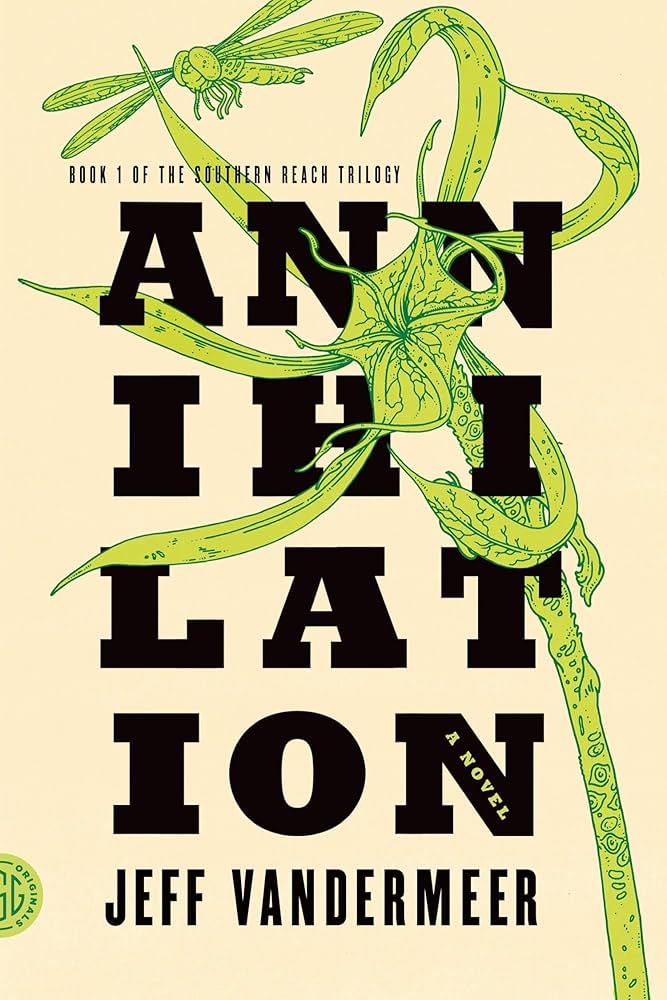
Jeff VanderMeer: Annihilation

8
Staff write-up
The Rev
Start with the book if you haven't seen the movie. Both are fresh, original, willing to go somewhere most genre fiction don't dare, and ending somewhere that leaves you uncertain you understood what you witnessed. Both are unique enough to enjoy in different respects.
Annihilation follows four women identified only by their professional roles, a biologist, a psychologist, an anthropologist, and a surveyor, as they enter Area X; the twelfth such expedition. Previous expeditions ended in mass suicide, gunfire, cancer, and complete psychological dissolution. The crew brings minimal technology including notebooks for retrieval in the event they don't make it back.
The naming convention, roles instead of names, is the novel's first and most important choice be the movie. It prevents attachment. It keeps the biologist at an analytical distance from everything, including herself. And it quietly establishes that whatever Area X does to people it does to their sense of individual identity first. By the end of the novel you understand why it withheld names.
What follows is a poignant and detailed look at the trajectory of our relationship with the natural world, wrapped in prose that borders on convoluted but rewards those willing to dig in. Area X can cause hallucinations and trickery, making it so that both us and the crew are unsure what can be trusted. It's a psychological threat reminiscent of The Thing, adding paranoia and fear and trust collapse on top of simple physical danger.
The Tower, which is actually a tunnel that descends underground and which the biologist alone calls a Tower, is the novel's central image. The other characters see a tunnel. She sees something else. That perception is the book's central thesis. We cannot trust our instruments. We cannot trust each other. We may not be able to trust ourselves.
The middle section loses some momentum. The descriptions of the environment are occasionally magnificent and occasionally exhausting, and the balance tips toward exhausting in the book's second third. The biologist's discovery of her husband's notebook, which should land as a devastating emotional gut punch, is handled too quickly while the surrounding ecological detail receives more space. The emotional stakes deserve the same granularity VanderMeer gives the biology.
The movie's bear attack sequence is one of the greatest horror scenes in recent memory. Its ability to mimic the voice of a dying crew member while hunting the survivors is beyond nightmarish. In the novel this creature is called the Moaning Creature and it appears exactly once, briefly, in the darkness, calling out in a humanlike voice before disappearing.
The film's ending featuring an alien doppelganger encounter felt forced to me, out of place. The novel's ending is simpler and stranger, the biologist choosing to remain in Area X to learn what she can about her husband and the environment. Less cinematic. More honest to who she is.
This is one of the rare situations where the film improved on the source material in specific ways while the source material maintained superiority in others. The bear. The doppelganger. The film wins both. The prose, the psychological interior, the ecological dread underneath the horror. The novel wins.
Consume both. I would suggest novel thencmovie, but either works.
Same vibe
Related Revs
Same desk

-1.jpeg)