Staff review
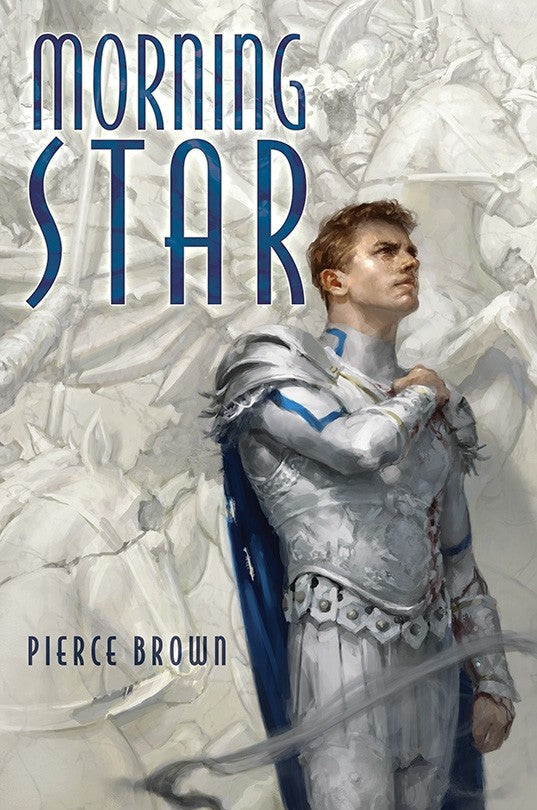
Pierce Brown: Morning Star
7.5
Staff write-up
The Rev
We pick up right after the devastating events of Golden Son. Darrow is trapped in a horrific prison of the Jackal's making. He contemplates taking his own life or admitting his crimes, but knowing his enemies have his family prevents him from giving up. The Jackal threatens to feed Darrow's family to the prisoners while offering Darrow a simple life of freedom. The psychological weight is crushing. His isolation becomes a prison for his mind just as much as his body.
Deep down in the dark, the Jackal claims Darrow belongs there like the worms hiding underground. He is kept starved and buried for nine months in a twisted reverse gestation. Paralleled against Eo's pregnancy being violently taken from him, and now the Jackal has engineered his own dark womb to psychologically unmake Darrow.
When Darrow eacapes, he finds his family alive and waiting with an army. However, his journey from a malnourished prisoner back to a legendary Martian figure goes on a little long for a series finale. It is necessary world building that probably should have happened in prior books. Still, Pierce Brown feels more at home here. He is clearly more comfortable in his own universe, and it is really starting to show. There is a great scene during Darrow's recovery where he loses a weightlifting challenge. He remarks that it is good the others see a Gold cannot always win. He could be referring to Victra, but it is highly possible he is seeing himself as a Gold after all this time. Or, at the very least, he sees himself as something much more than just a Red. The corruption arc that book one quietly set up has been running beneath the surface this whole time.
Not to be outdone by the heavy political aspects, the action is kicked up a notch as well. Once Darrow recovers and eventually runs into Mustang, things shift into high gear. But the central problem of this book, and the series as a whole, remains. There is no real sense of urgency and no central physical conflict to draw our attention. Sure, there is a lot going on, but what is the actual endgame? The characters themselves seem confused. If they overthrow the caste system, then what happens? When the goal is civilization level change, no single space battle ever feels decisive enough to carry the weight. Brown compensates with high personal stakes, but the macro level narrative keeps dissolving.
That is not to say the writing has not improved. It absolutely has, especially compared to the first book. There is no better example than comparing Eo's death to Ragnar's. Eo is killed quickly before we ever really get to know her. She is dispatched efficiently because Brown knew where he needed the plot to go and simply moved it there. You can feel the author's engineering. Ragnar, on the other hand, gets two painful, drawn out chapters. We sit with the loss exactly like Darrow sits with his dying friend. We are given time to process, to cope, to deny, and eventually accept it. Brown learned a valuable lesson between books. He finally learned to stop moving his characters forward before the grief can permiate.
It is odd that new, seemingly important characters are still being introduced this late in the game. But Romulus au Raa is easily the best introduced and most fleshed out character in the entire series upon first meeting. His appearance, motives, and aura are laid completely bare. Critically, he arrives with his own deep wounds tied back to earlier events rather than just existing to serve Darrow's story arc. The honesty of their face to face meeting is refreshing, and it immediately signals that he should play a major role in the wrap up.
When the epic space battle finally takes place and Darrow's fleet seems completely decimated, a wild thought occurred to me. For a legendary leader and a manufactured warrior who all these rebels look up to, Darrow has yet to actually win anything on his own. He has lost solo battles, he was defeated at the Institute & left for dead, and he is actively losing the war. Yet, someone always comes along and bails him out. His abilities are not tactical, his power is inspiring absolute loyalty in people who actually are brilliant. Sevro, Mustang, and Ragnar are the competent operators, a family. Darrow is simply the symbol they organize around. There is really no logical reason for anyone to follow him so blindly. His reputation absolutely precedes him, but what exactly is that reputation based on?
In one of the most heartfelt and poignant parts of the story, Darrow sits down to watch Roque's old recordings from the Institute with Cassius. They reflect on the better times before things got so convoluted and before so many friends died. It is a quiet, reflective moment that exists to make you feel the weight of their loss before the final act. It is a brutal reminder that everyone in this war was someone different before the stakes got large enough to corrupt them. It is easily one of the best character building moments of the entire saga.
When betrayal leads to the death of Darrow's uncle Narol, things fall completely apart. Alliances are broken and anarchy breaks out. This mirrors the original Institute where sects formed and allegiances were tested. It gives us a great look into Darrow's faith and negotiating skills for the first time.
Another massive betrayal follows, leaving Darrow wounded and defeated. Watching Darrow get beaten and hacked apart after trusting Cassius is intimate and devastating. Even Mustang cannot keep her focus as Darrow's hand is literally severed from his body. He has lost his friends, his hand, and possibly his second love. Her brother has completely stolen his trust. There is nothing left.
The best part of the entire series unfolds as a shackled Darrow and Mustang are forced to lay prostrate at the feet of the Sovereign. This is the ultimate visual argument the revolution has been building toward. It physically shows the massive gap between what Darrow represents and what he actually possesses in this hopeless moment. The Sovereign's callousness, the bitter betrayal of Cassius, and the sheer hopelessness radiating from Mustang and Darrow.
The final twist, which I will not spoil here, is a little too convenient. However, it makes for fantastic action and leaves our heroes to celebrate a bloody victory.
We end the story at the exact polar opposite of where we started. Instead of the death of love and Darrow's unborn child, we get the beautiful blossoming of a new family. This new family does not erase Eo or resolve the massive political chaos, and the giant question of what comes next still hangs wide open. But it insists that something worth building still exists. A new society will be built. It will not be easy, but for now, there is hope.
Same vibe
Related Revs
.jpeg)
Same desk
-1.jpeg)