Staff review
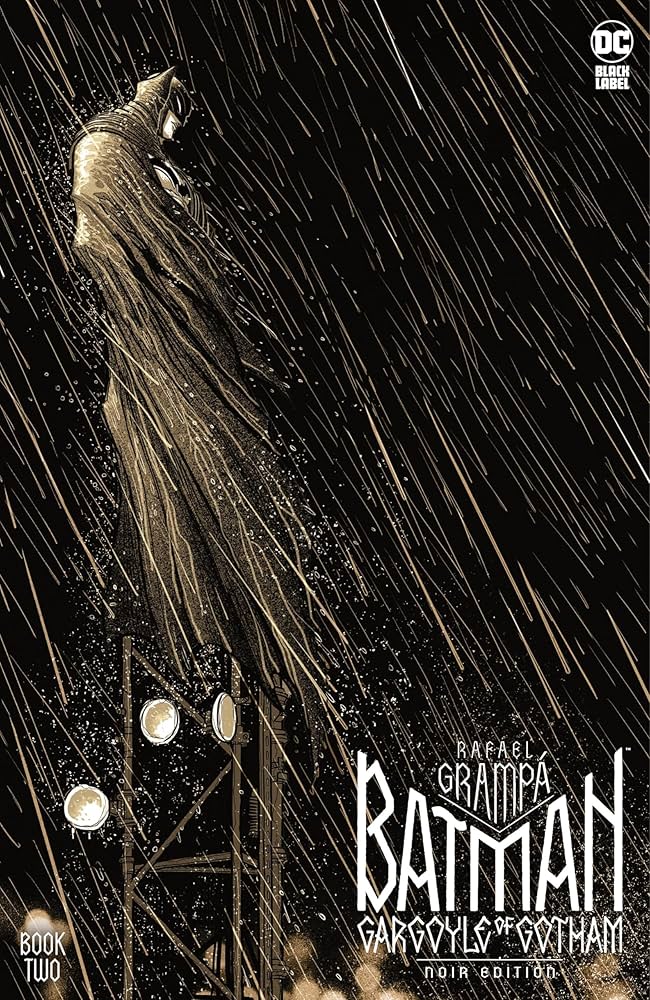
Batman: Gargoyle of Gotham
7.5
Staff write-up
The Rev
Batman has been on a secluded yet hot run over recent memory. They have mixed things up more than your average comic series in the past decade while still managing to leave the character relatively unmolested. So jumping into another standalone, Gargoyle of Gotham, came with massive expectations as I loved most of the recent Batman arcs.
Right away it feels like a Gotham centric story with its grit and grime on display, but that sense of dread and hopelessness is severely undercut by the art. It is entirely too light for the material. The line work is too loose, but not free and chaotic like Arkham Asylum or The Dark Knight Returns, if that makes sense. It reminds me of the sloppy Batman and Robin art from when Dick Grayson and Damian Wayne took over (an amazing set of volumes for the record). But it worked perfectly there because those specific stories were not trying to be pitch black psychological thrillers.
Story wise, it feels dense and squalid. It shows the absolute worst of Gotham. There is a heavy Tim Burton feel to it that the art just does not fully represent. The corrupt police force and the billionaire elites are on a personal crusade for absolute control over the poor. Coming from a Brazilian creator like Rafael Grampá, this class disparity feelslike a furious, real world commentary on socio-economic rage.
To make things even worse, someone is killing Gothamites in horrendous and brutal fashion. A shadowy figure takes out Batman with just a simple hammer (sidenote: Batman gets his ass kicked a lot in this series so I'm leaning to believe this is akin to year one timeline). He leaves his victims looking like pin cushions, intentionally paralyzing them so they are forced to witness their own torture and destruction.
The real kicker is that Batman is trying to go full time. He plans to kill off the Bruce Wayne persona so he can make way for Batman to be completely unencumbered by his civilian appearance. It is a rehashed exploration of psychological suicide, pushing the whole "Batman is the real face, Bruce is the mask" trope to its breaking point. Alfred acts as the voice of reason here, pointing out that the idea is ridiculous, but Bruce already has the entire ego death planned out.
Issue two is very entertaining, but it throws some massive shade on Bruce that might not sit well with longtime fans. Changing the events of the night his parents died feels a bit shoehorned in just to appease this specific story. That is the nature of DC Black Label though. Creators have the freedom to completely shatter canon and turn a random, tragic mugging into a grand conspiracy. The blind rage resulting in the paralysis of a junkie, only to reveal he was in fact the killer of Bruce's parents, feels a little too convenient. Bruce aggressively disrespecting everyone around him, like Alfred, Gordon, and Nia, feels entirely out of place. Will there be a satisfying payoff? Is he doing it intentionally to play up the elite status of Bruce? It's not clear to me.
The main mystery of who is behind all these murders is still an intriguing thread. Crytoon and Moth-er are nightmarish villains, almost characatures of them. Like combining the horrific appearance of clayface with the insanity of joker. They are a little cringy, but they act as twisted, physical manifestations of childhood trauma, perfectly mirroring Bruce's own arrested development. They could be interesting full time additions to the rogues gallery, but time will tell if they stick or even survive.
Issue three continues building and adding to the new rogues, but it is a highly disjointed and confusing read. The story is shaping up, however the addition of Little Joker to Doctorguise is an unsettling anti-batman Robin dynamic. In fact, this entire issue is basically just a string of unsettling scenes. In the background, the elite versus the poor story is also picking up pace, with Nia now acting as common enemy number one. The blood soaked finale finally brings things full circle.
Issue four, the finale, dices into the supernatural. Mixed with the sheer amount of new characters, it is a bit jarring and feels out of place in the grounded Batman mythos. The story is interesting yet confusing. When Bruce is finally pushed so far that it looks like he will actually break his cardinal rule, things start sliding back into place. The narrative parallel to Prometheus, literally harvesting darkness from a child Bruce like stolen fire, is a fascinating take on Batman's origin. It frames Gotham not just as a corrupted city, but as a parasitic organism that explicitly feeds on childhood trauma to sustain its own dark mythology. It is a brilliant concept, but one only focuses on in the final pages of this storyline.
The artwork in this final issue fits much better than the prior ones. It really only took a minor stylistic change from colorist Matheus Lopes to fix it. Going mostly black and white with sudden, stark hints of red, gold, and green makes things uniquely pop. Pulling back the saturation perfectly reflects Batman's binary worldview finally snapping into sharp focus. The impromptu bat suit also looks amazing. So kudos for turning the visuals around. The style is still a little muddy overall, but it is finally starting to work.
It is unfortunate that this visual and thematic clarity only arrives at the very end of the arc. But better late than never. We end with Bruce realizing his humanity is a necessary part of Batman. He grows the bat family, taking on these wounded children to look over. It is nicely wrapped up, but the storyline itself was incredibly confusing with so many moving parts and new characters. It will absolutely take a reread to truly digest everything and figure out its overall place in the mythos.
Gotham has never looked dirtier or grimier. The new rogues are conceptually brilliant, but too many were thrown at us way too quickly. I am going to temper my review and lean to the lower side until I can give it a repeat reading. But extra props to Rafael Grampá for the sheer inventiveness and unapologetic creativity.
Same vibe
Related Revs
.jpeg)
.jpeg)
-1.jpeg)
.jpeg)
.jpeg)
.jpeg)
Same desk