Staff review
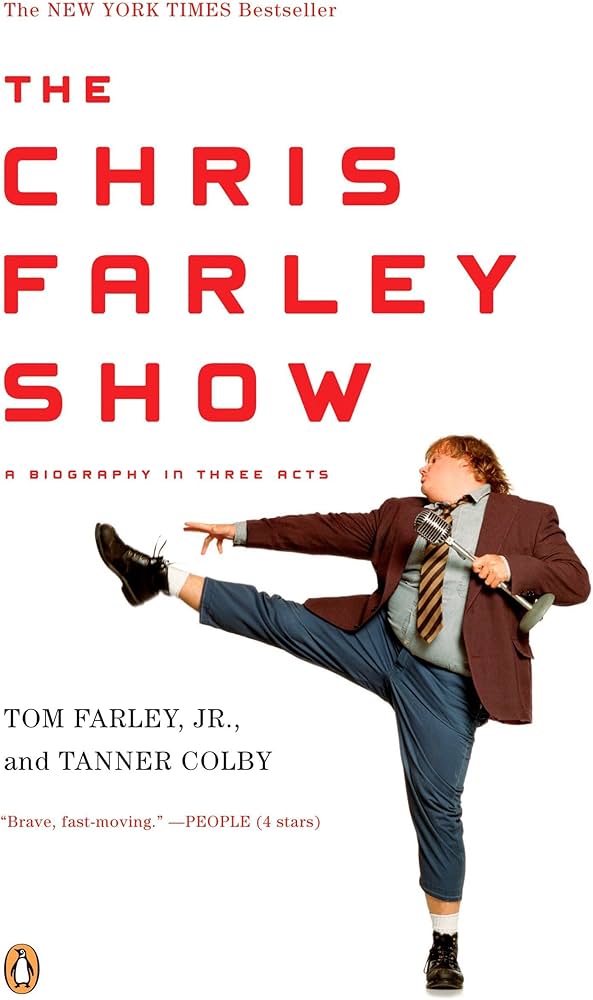
The Chris Farley Show: A Biography in Three Acts
6.5
Staff write-up
The Rev
The death of Chris Farley is a sad event in Hollywood history, but there's no real surprise behind it. The man lived fast and hard, and squandered himself and the devotion of everyone around him to addiction. By all accounts Chris seemed like an extraordinary person, a juggernaut of comedy. But his self-destruction shouldn't shock anyone who was paying attention.
Sidenote: The book is written by Tom Farley Jr., Chris's older brother, alongside journalist Tanner Colby. Tom has since founded the Chris Farley Foundation, dedicated to educating young people about addiction and substance abuse. The book is an act of grief and preservation in equal measure.
What would his career have looked like had he survived? Probably not what most people imagine. And here's the part the mythology gets wrong. Farley wasn't already fading. After three years of sobriety his career was actually at its creative peak. It was a string of professional disappointments that sent him back. Sober Chris Farley was thriving. That makes the ending considerably sadder and considerably more maddening than the simple "burn bright, burn fast" narrative. If he wasn't an addict? Who can say. It's one of the more genuinely painful questions in modern comedy history.
The book is a testament to the love curated through his life, but also a record of all he hurt along the way. It's told as an oral history, an amalgam of stories, interpretations, and insights drawn from nearly 100 interviews, democratically assembled through a multi-narrator structure. Which means there's no single thread or authority. No one voice owns the story. It's both the book's greatest strength and the source of its shapelessness.
The parallel with John Belushi should have been a longer plot point and it's where the book frustrates most. It's referenced multiple times but treated as an afterthought rather than a structural spine. The tragic irony is that Tanner Colby, the book's co-author, also wrote Belushi: A Biography. The man who covered that destruction in full detail co-wrote this one. He knew exactly what map was being followed and exactly where it ended. That the Belushi parallel still feels underexplored given that context is the book's most puzzling editorial choice.
It's unfortunate that the very demon that made Farley special is also the one that led to his destruction. His physical comedy and self-deprecation were rooted in genuine insecurity, and those same insecurities fueled his addiction. You seemingly couldn't have one without the other. His demons didn't create him, but they grew alongside him, matured with his career, fed on his success and his failures in equal measure. Not responsible for making him who he was. Just inescapable once they took hold.
He was 33. The same age as Belushi. He had the cautionary tale in front of him. He idolized the man. He had the script, knew the ending, and hit the same mark anyway.
The Chris Farley Show is a haunting eulogy from the people who loved him, shaped by a grief that never quite resolves into meaning because addiction rarely offers meaning. Just loss.
Same desk
-1.jpeg)