Staff review
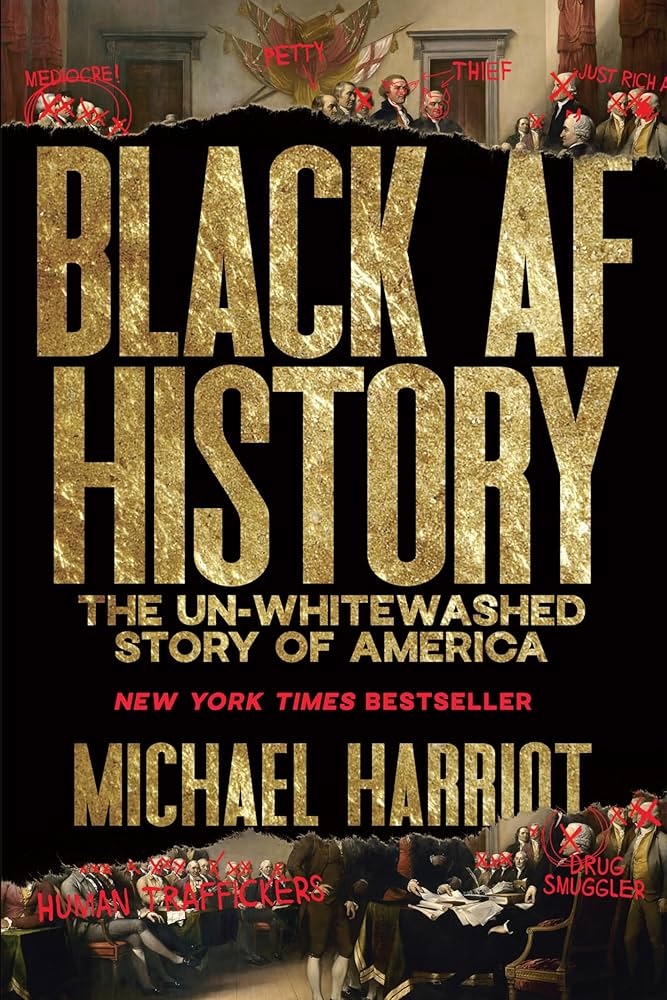
Michael Harriot: Black AF History - The Un-Whitewashed Story of America
8
Staff write-up
The Rev
Spoiler alert: White people are the worst. Source: Am white people.
This book is overall a great primer in what's wrong with this world, the writing is witty and educational, teetering between textbook and comedy while covering topics that make you cringe at how poorly black people have been treated in this society.
What starts as a humorous observation immediately gets backed up by brutal historical facts. For example, Jamestown was a catastrophic failure, and John Smith was a liar and a complete disgrace. We learn the tragic reality that Pocahontas died after her return was negotiated multiple times as a political pawn. The book even touches on the gruesome cannibalism of a 14 year old girl simply because the colonists could not figure out how to ration food. It begs the question: were they settlers or invaders? Either way, they were dangerously incompetent. What starts incredibly strong in the first chapter unfortunately fades over the next few. The narrative shifts into covering topics that feel more at home in a standard, high school history textbook than the rebellious promise of this book's title. But things right themselves again when the book tackles major uprisings. Events like the Sugar House revolt, the Stono Rebellion, and the true grit of the Underground Railroad are covered brilliantly in chapter five. I honestly learned more about the tactical, military genius of Harriet Tubman in a single chapter than I did in the entirety of my scholarly career.
The middle section gets a little muddled, covering less interesting topics in a less engaging fashion. When a narrative tries to cover too much ground without diving deep, it feels exactly like playing an open world game padded with meaningless travel instead of sticking to a tight, linear story. Some of the most fascinating supplementary figures, like Sister Rosetta Tharpe, get minimal page time despite being incredibly important. Tharpe has long been recognized as the true creator of rock and roll. She led a wildly interesting and controversial life, yet her legacy is rushed through in only a few brief paragraphs. This is common in the book to get more info out without digging too deep into any one topic.
Chapter 13, titled "Thug Life," stands out as one of the more entertaining sections. However, it highlights that recurring problem with the book's pacing. Harriot tries to cover a massive amount of historical ground but rarely goes into enough depth. I would have loved it if the author dug deeper into specific moments instead of skimming across so many different eras. It ends up feeling a bit disjointed. Covering the heartbreaking tragedy of Emmett Till and then rapidly pivoting to "posse girls" in the exact same chapter feels tonally jarring and unconnected.
The final retrospective on our current political and social climate is easily one of the most poignant moments in the text. Once again, I just wish it was delved into a bit deeper. Ultimately, this is a fantastically flawed book. It never fully lives up to its own zany, irreverent promise, yet it remains completely eye opening and high quality. It never hits below the belt, but it always makes sure to tell it exactly like it is.
Same desk
-1.jpeg)